 Ultimate guide
Are Heavy-Duty Exit Devices Worth the Investment?
Quick Summary
Heavy duty exit devices are worth the investment on busy doors because they use thicker castings, reinforced internals, and higher cycle ratings. They withstand constant daily use, resist forced entry and impact, and need fewer repairs and less downtime over time. Low-traffic doors may not justify the upgrade.
- Heavy-duty devices use thicker castings and reinforced internal components.
- They are tested to a higher ANSI/BHMA grade, typically Grade 1.
- They cost more upfront but last longer under heavy use.
- Standard devices suit low-traffic doors, while heavy-duty suits main entrances.
- Monthly checks of latch retraction and strike alignment prevent emergency jams.
Table of Contents
- What Exit Devices Are and How They Work
- Standard vs. Heavy-Duty Exit Devices: Pros, Cons, and Comparison
- Emergency Egress and Life Safety Requirements Under NFPA 101
- ADA Compliance for Commercial Exit Devices
- Total Cost of Ownership, Installation Considerations, and Retrofit Planning
- How to Maintain Panic Bars to Prevent Failures
- Book a Heavy-Duty Exit Device Assessment for Your Council Bluffs Building
- Frequently Asked Questions
What Exit Devices Are and How They Work
Last Updated: November 23, 2026
Heavy-duty exit devices are the push bars and panic hardware on commercial doors that let occupants leave instantly without a key, and they are built to take years of daily abuse. The questions below come up often for commercial doors.
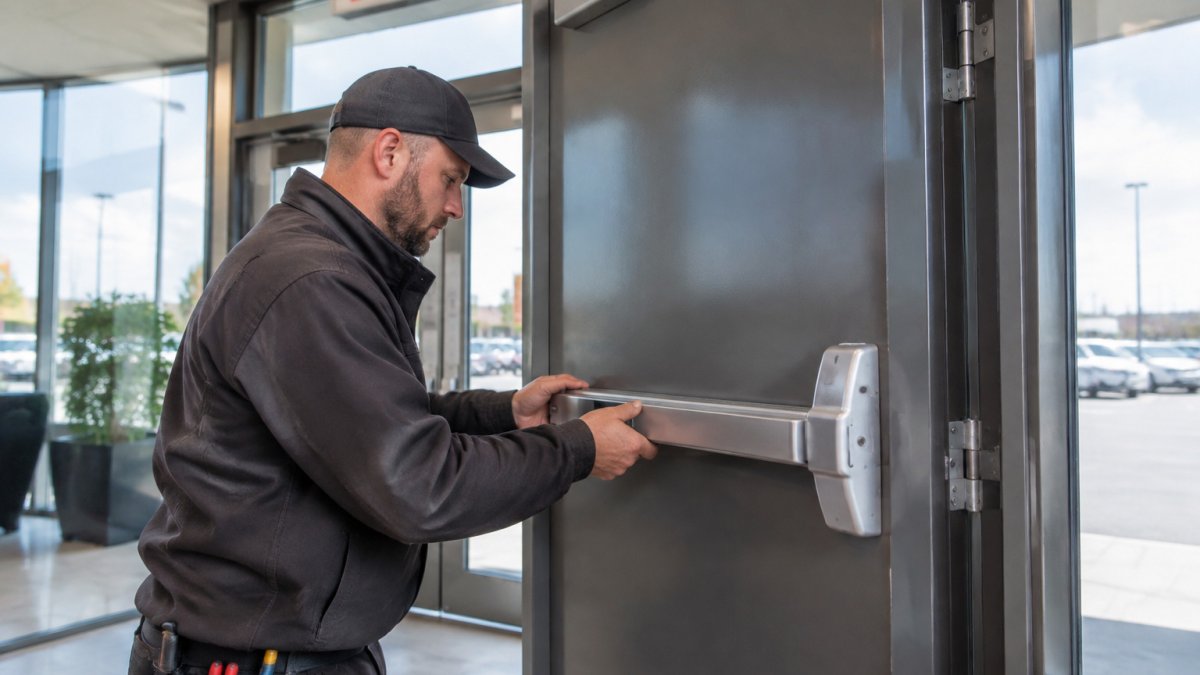
An exit device is a mechanism mounted on the inside of a door. Pushing the bar retracts the latch bolt, so the door opens without anyone needing a key or a knob. The bar is the visible part. Behind it sit the latch, the strike that receives the bolt, and the trim that controls whether the outside of the door can be opened.
Most commercial exit devices fall into three mounting styles:
- Rim devices mount on the face of the door and are the most common type.
- Surface vertical rod devices attach to the door face and drop rods into the top and bottom of the frame, locking the door at several points.
- Mortise devices are recessed into the door, giving a cleaner look at higher cost.
Watch out: A device rated for light residential use will fail quickly on a busy storefront, so match the rating to the door's traffic rather than to the price.
Standard vs. Heavy-Duty Exit Devices: Pros, Cons, and Comparison
The difference between a standard and a heavy-duty device comes down to construction and cycle rating. Standard devices are designed for lighter, intermittent use. Heavy-duty devices use thicker castings, reinforced internal components, and higher cycle ratings, and they are tested to a higher grade under ANSI/BHMA standards.
| Feature | Standard Device | Heavy-Duty Device |
|---|---|---|
| Intended traffic | Light or intermittent | High-traffic, daily use |
| Internal construction | Lighter-gauge components | Reinforced, thicker castings |
| Typical ANSI/BHMA grade | Lower grade | Grade 1 |
| Impact and vandal resistance | Limited | Higher |
| Upfront cost | Lower | Higher |
| Service life under heavy use | Shorter | Longer |
Pros of heavy-duty hardware:
- Withstands constant use in warehouses, schools, and retail entrances
- Better resistance to forced entry and impact
- Fewer breakdowns and callbacks over time
Cons of heavy-duty hardware:
- Higher purchase and installation cost
- Often heavier, which can require a stronger door and frame
- Overspecifying a low-traffic door adds cost with no real benefit
Many businesses find that the right answer is a mix: heavy-duty devices on the main entrances and exits, standard devices on secondary or rarely used doors.
Emergency Egress and Life Safety Requirements Under NFPA 101
Egress hardware is a life safety issue, and the rules that govern it are set out in NFPA 101, the Life Safety Code. The code generally requires that doors serving as exits be operable from the inside without a key, tool, or special knowledge. The exact requirements depend on the occupancy type and the local adopted version of the code, so check with your local building official before finalizing a specification.
NFPA 101 Life Safety Code overview
Practically, this means panic hardware on any door where a crowd may gather, such as assembly spaces, schools, and high-occupancy retail. Your locksmith or door hardware contractor should confirm the device meets the code for your specific building.
ADA Compliance for Commercial Exit Devices
The Americans with Disabilities Act sets requirements for how exit devices must operate. Push bars and levers should be operable with one hand, without tight grasping or twisting. Hardware mounted too high or requiring a key on the egress side can create a barrier for people with limited hand strength or reach.
ADA Standards for Accessible Design
When you specify or retrofit a device, confirm the bar height and operating force against the ADA standards that apply to your building.
Total Cost of Ownership, Installation Considerations, and Retrofit Planning
Looking only at the purchase price understates what an exit device really costs. A cheaper device that fails every couple of years can cost more over its life than a heavy-duty unit that lasts. Most facility managers find that the real comparison is total cost of ownership: purchase, installation labor, routine maintenance, repair parts, service calls, and the downtime cost of a door that is out of service.
A practical way to compare heavy-duty versus standard devices is to build a simple lifecycle worksheet for each egress door. List the device type, the door material and width, the traffic volume, and the opening type (single, pair, or with a coordinator). Then estimate four cost buckets over a five- to ten-year horizon:
- Purchase: the device, trim, and any electric options such as request-to-exit sensors or electric latch retraction.
- Installation: labor to fit the device, reinforce the door, adjust the strike, and commission the opening. A retrofit onto an unprepared door costs more than a like-for-like replacement.
- Maintenance and repair: inspection time, lubrication, adjustment, and replacement of wear parts such as the latch, strike, and closer arm.
- Downtime: the cost of a door being unusable or propped open while waiting for a service call, especially on a main entrance.
Heavy-duty devices typically cost more up front but reduce the frequency of repair and replacement, so the crossover point depends on traffic. On a low-traffic back door, a standard device may never justify the upgrade. On a main entrance that cycles hundreds of times a day, the heavy-duty unit often pays back through fewer service calls and less downtime. The right answer is usually a mix: heavy-duty devices on the busiest exits and standard devices on secondary doors.
Installation considerations and retrofit planning
Installation quality determines whether a good device performs. Before ordering, take field measurements of the door leaf thickness, width, and height, the frame type and material, and the existing preparation. Confirm the device is compatible with the door and frame, and check whether the door needs reinforcement, a different strike, or a new closer. On a retrofit, the existing cutouts may not match the new device, so plan for patching or re-prepping the door.
Commissioning matters as much as bolting on the hardware. After installation, verify that the bar retracts the latch fully, the door latches cleanly, the closer controls the swing, and any electric function releases on alarm. Keep the installation instructions and a record of the device model and finish for future service.
Watch out: A retrofit that skips door reinforcement or strike adjustment can leave a heavy-duty device misaligned, which accelerates wear and can defeat the reliability you paid for. If the door or frame is damaged, budget for repair before installation rather than after.
Pricing depends on the device type, the door, the finish, and whether it includes electrified or access-controlled features. Contact Blackshirt Lock & Key for a quote tailored to your door. If you are planning a retrofit, our commercial door hardware installation guide walks through what the process involves, and our commercial door lock installation insurance guide explains how insurance factors into hiring a commercial installer.
How to Maintain Panic Bars to Prevent Failures
Most exit device failures are preventable. The goal of a maintenance program is to catch wear before a bar jams during an emergency. A workable schedule for a busy commercial building is:
- Monthly: push the bar and confirm the latch retracts fully and springs back; check that the door latches and the strike lines up without rubbing; listen for grinding or rattling.
- Quarterly: inspect for loose screws, cracked housings, and worn latch or strike surfaces; confirm the door closer closes and latches the door without assistance; test any electric function, including request-to-exit sensors and alarm release.
- Annually: have a qualified technician inspect the device, lubricate moving parts per the manufacturer's instructions, check door and frame alignment, and replace worn wear parts before they fail.
Warning signs that a device needs attention
- The bar feels spongy, sticks, or does not return to its rest position.
- The door does not latch reliably, or the latch rubs on the strike.
- The door closer slams, drags, or fails to close the door fully.
- Screws work loose repeatedly, or the device housing is cracked or bent.
- The outside trim or electric release behaves inconsistently.
A common mistake is ignoring a slow or sticky bar until it jams during an emergency. Address small problems early, and keep a record of service dates and device models so parts can be matched quickly.
Troubleshooting basics
If the bar does not retract the latch, check for a misaligned strike, a worn latch, or a door that has sagged on its hinges. If the door will not stay latched, inspect the closer and the strike before assuming the device is at fault. If an electric function fails, verify power and the request-to-exit sensor before replacing hardware. When in doubt, call a commercial locksmith rather than forcing the mechanism, since forcing a jammed bar can bend internal components.
Watch out: A door that will not close properly can keep the latch from engaging, which looks like an exit device failure but is often a closer or hinge problem. If a door closer is the source of the trouble, our guide on how to fix a commercial door closer that won't close covers the common causes.
Book a Heavy-Duty Exit Device Assessment for Your Council Bluffs Building
Heavy-duty exit devices earn their cost on busy doors where reliability and occupant safety matter most. For a Council Bluffs business, the fastest way to know what your building needs is an on-site assessment. Blackshirt Lock & Key is a fully mobile, fully insured locksmith, so we come to your door rather than making you wait at a shop.
Schedule a commercial locksmith visit in Council Bluffs to get an exit device assessment, or reach our Omaha team if your building is on that side of the river. We provide straightforward pricing with no hidden fees, and we will tell you plainly whether a heavy-duty device is worth it for each door. Call Blackshirt Lock & Key today to get started.
Frequently Asked Questions
What is the difference between a standard and heavy-duty exit device?
A standard exit device is built for lighter use, typically residential or low-traffic commercial doors. Heavy-duty exit devices use thicker stainless steel or reinforced components, more robust latch mechanisms, and are rated for higher cycle counts. Heavy-duty models are generally rated ANSI Grade 1, the highest grade for durability under constant use. For doors that open dozens or hundreds of times a day, such as storefronts, warehouses, and loading docks, the heavier construction reduces wear and the frequency of repairs.
Are panic bars required by fire codes in commercial buildings?
In many commercial occupancies, the NFPA 101 Life Safety Code requires exit doors serving occupant loads above a set threshold to be equipped with panic hardware or fire exit hardware that opens with a single motion. Requirements depend on occupancy type, occupant load, and the local adopted code edition, so confirm with your local fire marshal or building official before ordering hardware. A licensed locksmith can help identify which devices your doors need to meet those requirements.
Can heavy-duty exit devices be installed on existing storefront doors?
Often yes, but it depends on the door's construction, width, thickness, and frame preparation. Existing storefront doors may need reinforcement, new strike plates, or modified mounting locations to accept a rim or surface vertical rod device. Retrofit planning should include checking door compatibility, fire rating, and the required egress width before purchasing. Pricing depends on the device type, door condition, and labor, so request a quote for your specific door rather than relying on general estimates.