 ultimate-guide
Commercial Door Hardware Installation Services Guide
Table of Contents
- What Commercial Door Hardware Installation Services Actually Cover
- Hardware Selection Guide for Specific Industries
- ADA Compliance Door Hardware Requirements Every Business Must Meet
- Commercial Door Hardware Maintenance Checklist for Facility Managers
- Commercial Door Closer Installation Cost: What Drives the Price
- Why Licensed and Bonded Commercial Door Hardware Installation Matters
- Emergency Repair Services and When to Call Right Away
- Frequently Asked Questions
Last Updated: August 24, 2026
What Commercial Door Hardware Installation Services Actually Cover
Commercial door hardware installation services cover hardware specification, physical installation, code compliance verification, and post-installation testing on commercial-grade doors and frames. The hardware is heavier, code requirements are stricter, and failure consequences are far more serious than residential work.
At Blackshirt Lock & Key, we handle commercial door hardware for businesses that need the work done right the first time. Below, we'll break down exactly what these services include, what drives cost, and how to keep your hardware performing long after installation day.
Door Closers, Panic Bars, and Exit Devices
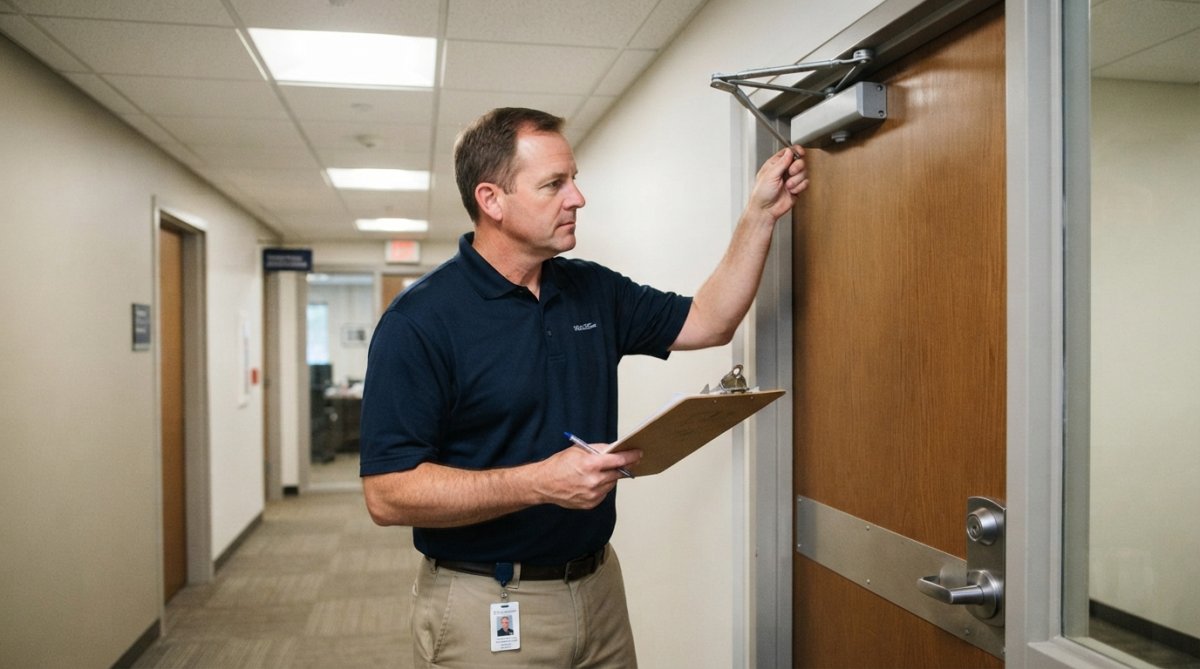
Door closers are mechanical or electromechanical devices that control the speed and force at which a door returns to its closed position. In commercial settings, properly calibrated door closers directly affect fire containment, ADA compliance, and energy efficiency.
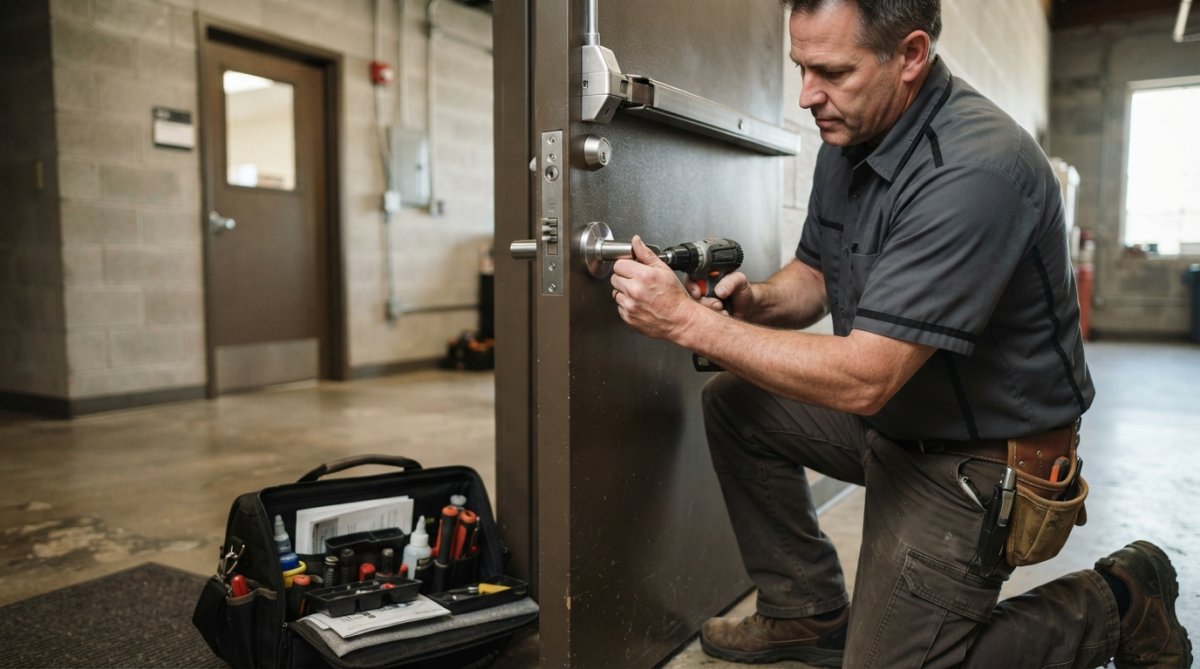
Panic bars (also called exit devices or push bars) are horizontal bar mechanisms that allow occupants to exit quickly under emergency conditions without operating a separate latch. According to the National Fire Protection Association's life safety codes, exit devices on certain egress doors are required by code in commercial occupancies. Installation requires precise alignment with the door frame and strike plate, plus testing under load.
Common commercial door closer and exit device work includes replacing worn or hydraulically failed closers, installing surface-mounted or concealed closers on hollow metal doors, fitting panic bars on fire-rated egress doors, adjusting closing speed to meet ADA door-opening force limits, and installing electric exit devices tied into access control systems.
Mortise Locks, Electric Strikes, and Access Control Integration
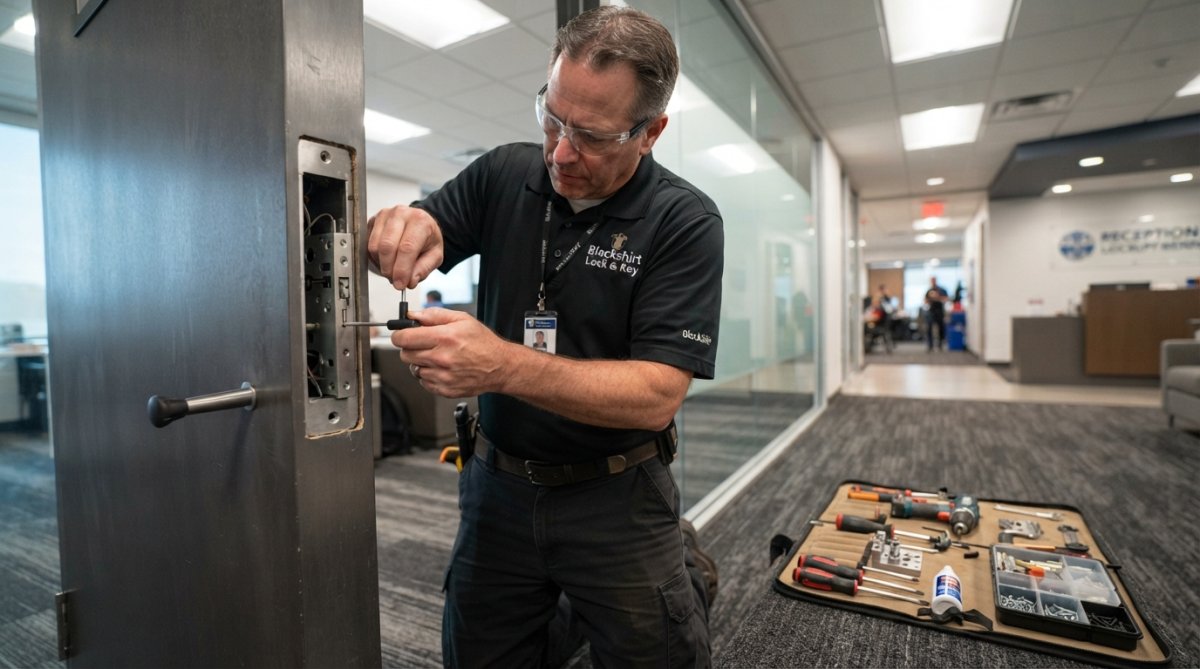
Mortise locks are heavy-duty lock bodies recessed into the door edge rather than surface-mounted. They're the standard for commercial applications because they're significantly more resistant to forced entry than cylindrical locks.
Electric strikes replace the static strike plate with an electrically controlled version that releases the latch when a signal is received from an access control panel, keypad, or card reader. This is how most commercial keyless entry systems work in practice.
The integration of mortise locks, electric strikes, and access control systems requires both locksmith expertise and low-voltage wiring knowledge. When the locksmith and access control technician aren't coordinating, you end up with misaligned hardware, failed strikes, and security gaps that nobody owns.
Hardware Selection Guide for Specific Industries
The wrong hardware choice for your industry can mean a failed inspection, a voided insurance claim, or a genuine safety incident.
Retail and Hospitality: High-traffic doors need heavy-duty hinges rated for frequent cycling, commercial-grade door closers with adjustable closing force, and mortise locksets with hardened steel bolts. Panic bars on rear egress doors are typically required by local fire codes.
Healthcare Facilities: Hands-free operation is a priority. Automatic door operators, push-pull hardware with lever handles, and electric strikes controlled by access control systems reduce cross-contamination risk. Fire-rated doors with self-closing hardware are required throughout.
Industrial and Warehouse: Hollow metal doors with reinforced frames are standard. Latch guards protect against pry attacks on outswing doors. Heavy-duty thresholds and weatherstripping control dust, temperature, and noise. Master key systems allow tiered access across large facilities.
Office Buildings: Access control systems with key card or keypad entry are common at main entries, with mortise locks or cylindrical locksets on interior offices. Electric strikes tied to a buzzer system at reception are practical and cost-effective.
| Industry | Priority Hardware | Key Consideration |
|---|---|---|
| Retail / Hospitality | Panic bars, heavy-duty closers | High cycle rating, fire egress compliance |
| Healthcare | Automatic operators, electric strikes | Hands-free operation, infection control |
| Industrial / Warehouse | Hollow metal doors, latch guards | Forced-entry resistance, master key systems |
| Office Buildings | Mortise locks, card readers | Access tiering, visitor management |
ADA Compliance Door Hardware Requirements Every Business Must Meet
ADA compliance door hardware requirements are defined under the ADA Standards for Accessible Design published by the U.S. Department of Justice, and they apply to virtually every commercial building open to the public.
The key requirements that affect hardware selection and installation:
- Door opening force: Interior hinged doors must require no more than 5 pounds of force to open. Fire doors are exempt but should be as light as the fire rating allows.
- Hardware operability: All handles, pulls, latches, and locks must be operable with one hand without tight grasping, pinching, or twisting. Lever handles, push bars, and loop pulls are compliant.
- Closing speed: Doors with closers must take at least 5 seconds to close from the 90-degree open position to 12 degrees from the latch.
- Threshold height: Thresholds on accessible routes cannot exceed 0.5 inches in height. Beveled thresholds are required where height changes occur.
- Clear width: Doors on accessible routes must provide at least 32 inches of clear opening width.
ADA door hardware compliance isn't a one-time checkbox. Hardware drifts out of adjustment over time. A door closer that passed inspection three years ago may now require 9 pounds of force to open because hydraulic fluid has degraded. Routine calibration maintains compliance.
Commercial Door Hardware Maintenance Checklist for Facility Managers
Preventative maintenance on commercial door hardware is one of the highest-return activities a facility manager can schedule. Most hardware failures develop gradually through misalignment, lubrication loss, or mechanical wear.
The following checklist covers core inspection points on a quarterly basis:
Door Closers:
- Check closing speed: door should close fully without slamming or failing to latch
- Check latch speed: final inch of travel should be smooth and positive
- Inspect arm and bracket for cracks or loose fasteners
- Look for hydraulic fluid leaks around the body
Panic Bars and Exit Devices:
- Test push force: bar should release with minimal effort
- Inspect dogging mechanism for proper function
- Check rod and latch alignment with strike
- Verify the door latches securely when closed
Hinges and Pivots:
- Check for loose screws; tighten or replace with longer fasteners if stripping
- Look for uneven gaps at the top and bottom of the door (sign of hinge sag)
- Lubricate pivot points with dry lubricant to avoid attracting dust
Mortise Locks and Cylindrical Locksets:
- Test deadbolt and latch operation: both should extend and retract smoothly
- Check strike plate alignment: latch should not drag on the strike
- Inspect cylinder for signs of wear or tampering
Thresholds and Weatherstripping:
- Check seal contact along the full door perimeter
- Look for tears, compression set, or gaps in weatherstripping
- Confirm threshold is secured and not creating a trip hazard
Access Control Hardware:
- Test card readers and keypads for response time and accuracy
- Verify electric strike releases cleanly on valid credential
- Check wiring connections at the strike and controller
Troubleshooting Common Hardware Failures Before They Become Emergencies
The biggest mistake facility managers make is waiting for complete failure before calling for service. Most hardware problems announce themselves well in advance.
Door won't latch consistently: Usually a strike plate alignment issue caused by building settlement or hinge wear. The fix is typically a strike plate adjustment or hinge replacement.
Door closer slams shut: The latch speed valve needs adjustment. If adjustment doesn't hold, the closer body is likely worn and needs replacement. Slamming doors are also an ADA compliance issue.
Panic bar doesn't retract the latch: Check the rod-to-latch connection first. If the rod is intact, the latch mechanism inside the panic bar body may be worn. This is a safety-critical failure requiring urgent attention.
Electric strike doesn't release: Start with the power supply. If voltage is present at the strike terminals, the strike solenoid has failed. If voltage is absent, trace the wiring back to the controller.
Key turns but lock doesn't engage: The mortise lock cam or tailpiece is worn or broken. This requires lockset replacement.
Commercial Door Closer Installation Cost: What Drives the Price
Commercial door closer installation cost varies based on hardware type, door and frame configuration, and whether existing hardware needs removal and disposal.
The main cost drivers:
- Hardware grade: Commercial-grade closers, panic bars, and mortise locks cost significantly more than residential equivalents, reflecting cycle ratings, material quality, and warranty coverage.
- Door and frame type: Hollow metal doors with standard prep cutouts are straightforward. Wood doors, aluminum storefront frames, or non-standard configurations add labor time.
- Access control integration: Adding electric strikes, wiring, and controller connections is a separate scope of work with its own labor component.
- Emergency vs. scheduled service: Emergency repair calls carry a premium over scheduled installation work.
- Quantity: Multi-door projects typically reduce the per-door cost compared to single-door service calls.
For current pricing on commercial door hardware installation, visit the Blackshirt Lock & Key pricing page or call for a quote. Pricing is straightforward, with no hidden fees added after the work is done.
Why Licensed and Bonded Commercial Door Hardware Installation Matters
Licensed and bonded installation is a meaningful distinction that affects your liability exposure, your ability to pass inspections, and your recourse if something goes wrong.
A licensed contractor has demonstrated competency through testing or verified experience. A bonded contractor carries surety coverage that protects you if the work is abandoned or causes damage. When dealing with fire-rated doors, ADA-required hardware, or access control systems tied to building security, the stakes are high enough that this matters.
According to the International Building Code requirements maintained by the International Code Council, fire-rated door assemblies must be installed and maintained in accordance with NFPA 80. That standard requires installation by individuals knowledgeable in fire door assembly requirements. Hiring an unlicensed installer who voids your fire door rating creates a liability problem that shows up at the worst possible time.
The practical checklist before hiring:
- Verify the contractor holds a current locksmith or contractor license in your state
- Confirm they carry general liability insurance for commercial work
- Ask for the specific hardware model and grade being installed
- Get the warranty terms in writing
Blackshirt Lock & Key is fully insured for commercial work. That's documentation you can request before the job starts.
Emergency Repair Services and When to Call Right Away
Some hardware failures are inconveniences. Others are emergencies. Knowing the difference determines whether you're making a scheduled service call or a same-day call.
Call immediately for:
- A panic bar or exit device that fails to release (blocked egress is a life-safety violation)
- A door that won't close or latch on a fire-rated corridor
- A broken mortise lock on a storefront door leaving the building unsecured overnight
- An electric strike failure that locks authorized personnel out of a secure area
- A door frame that has separated from the wall, compromising the door's structural integrity
Schedule within the week for:
- A door closer that is slamming or failing to close completely
- Weatherstripping that has failed but the door still locks
- A cylinder that is stiff or difficult to turn
- Strike plate misalignment causing the latch to drag
Emergency door repair services exist because commercial buildings can't afford extended security gaps. As documented in NFPA 80 Standard for Fire Doors and Other Opening Protectives, fire door assemblies that fail to close and latch must be taken out of service or repaired immediately.
Most hardware emergencies have a common root cause: deferred maintenance. The panic bar that fails at 11 PM on a Friday usually showed signs of wear weeks earlier. A quarterly maintenance schedule catches the majority of these failures before they become after-hours emergencies.
Commercial door hardware failures don't announce a convenient time to happen. Whether you're dealing with a broken exit device, a misaligned mortise lock, or a door closer that's been slamming for months, the cost of waiting is always higher than the cost of fixing it. Blackshirt Lock & Key provides fully mobile commercial door hardware installation and repair services, coming directly to your location with no shop-based wait times. Our team is fully insured, pricing is straightforward with no hidden fees, and we handle everything from scheduled hardware replacement to same-day emergency calls. Call now to get the right hardware installed correctly.
Frequently Asked Questions
What is included in commercial door hardware installation services?
Commercial door hardware installation covers fitting and adjusting door closers, panic bars, exit devices, mortise locks, electric strikes, hinges, pivots, thresholds, and weatherstripping. A qualified installer also handles hollow metal door frame prep, access control system wiring, and verifies that all hardware meets building code and ADA requirements. For businesses with multiple entry points, a contractor can coordinate master key systems and keyless entry programming.
How do I know if my commercial door hardware meets ADA requirements?
The Americans with Disabilities Act requires door hardware to be operable with one hand and without tight grasping, pinching, or twisting. Lever handles and push-pull hardware generally pass; round knobs typically do not. Door closers must allow at least 5 seconds to close from 90 degrees, and opening force on interior doors cannot exceed 5 lbf. A locksmith or door hardware installer can audit your existing hardware against these standards and identify any components that need replacement.
How often should commercial door hardware be inspected or replaced?
Most facility managers schedule a full commercial door hardware inspection every six months. High-traffic doors, retail entrances, loading docks, and stairwell fire doors, benefit from quarterly checks. Door closers typically last 10 to 15 years with regular lubrication and adjustment. Panic bars and exit devices should be tested monthly per NFPA 101 life safety code. Replace any hardware showing visible corrosion, misalignment, or slow latch engagement before it fails entirely.
Can a mobile locksmith handle heavy-duty commercial door hardware?
Yes. A fully insured mobile locksmith with commercial experience carries the tools and hardware inventory to install and service door closers, panic bars, mortise locks, electric strikes, and access control components on-site. Mobile service eliminates shop wait times and is especially practical for property managers handling multiple locations or businesses needing emergency repair without shutting down operations. Confirm the technician is insured for commercial work before scheduling.