 How-to
7 Steps to Verify Locksmith Insurance and Credentials
Last Updated: November 12, 2026
Quick Summary
To verify locksmith insurance and credentials, search the Iowa Secretary of State business entity registry by legal name, confirm the entity status reads active, check City of Council Bluffs licensing, and request a certificate of insurance. Then call the insurer directly to confirm the policy is active and covers locksmith work.
- Iowa has no state locksmith license, so the insurance check becomes your main safeguard.
- A certificate of insurance is a snapshot, not a guarantee, and can be altered or stale.
- Call the insurer's policy-services number, not a number printed on the locksmith's paperwork.
- Ask for the total price in writing before work starts, including after-hours and hardware fees.
- A business registration proves the entity exists but says nothing about skill or insurance.
Table of Contents
- Why Verifying a Locksmith Matters Before You Hire
- How to Verify Locksmith Insurance and Credentials Online
- Locksmith Proof of Insurance: What Documents to Request
- Questions to Ask Before Hiring a Locksmith
- Locksmith Estimate and Service Fees: What to Confirm Upfront
- What to Do When Locksmith Licensing Is Not Required in Your Area
- Emergency Call Safeguards for Council Bluffs Homeowners
- Book a Verified, Insured Locksmith for Your Next Job
- Frequently Asked Questions
Why Verifying a Locksmith Matters Before You Hire
A locksmith has keys to your home, your car, or your storefront.
Most people don't check.
Here's what most guides get wrong: they treat verification as a paperwork formality. It isn't.
This guide walks you through the steps to verify locksmith insurance and credentials in Council Bluffs.
For a broader local walkthrough, see our guide to finding honest locksmiths in Council Bluffs.
How to Verify Locksmith Insurance and Credentials Online
To verify a locksmith online, search the state business registry by legal name, confirm the entity is active, cross-check any local business license, and request proof of insurance directly.
Start with these steps:
- Get the company's legal name, not just the name on the van or the phone greeting
- Search the Iowa Secretary of State business entity search at sos.iowa.gov by that legal name
- Confirm the entity status reads active and note the registered agent and principal address
- Check with the City of Council Bluffs for any local business license or permit requirement
- Request a certificate of insurance and confirm it with the insurer (covered in the next section)
A record that exists is not a record that's valid. An Iowa business entity can show up in the registry as inactive, dissolved, or delinquent, and a lapsed record still appears in search results.
Searching the Iowa Business Registry and Local Records
Verification in Iowa centers on business registration, local permits, and direct credential checks rather than a state locksmith license lookup.
Search in this order:
- Iowa Secretary of State business entity search (sos.iowa.gov): confirm the company is a registered business entity, note the entity number, status, and registered agent
- City of Council Bluffs business licensing: call the city clerk's office to ask whether a general business license or a specific permit applies to locksmith or property-access work at your address
- Pottawattamie County records: confirm any assumed business name (DBA) filing matches the name on your quote
- Trade or industry directories: useful for reputation, never a substitute for official records
For official consumer guidance on avoiding home service scams, the Federal Trade Commission consumer advice is a solid starting point.
Confirming Active Status and Business Registration
A business profile that lists a name and a phone number tells you almost nothing. What you want is a paper trail that ties the name on the quote to a real, active entity at a real address.
Look for these signals:
- A legal business name that matches the name on the quote, the certificate of insurance, and the invoice
- A physical business address in Iowa or the Omaha metro, not just a call center number with an out-of-state area code
- An entity status in the Iowa registry that reads active, not dissolved or delinquent
- A registered agent listed with the Secretary of State, which is a strong sign of a real operation
Watch out: a locksmith who can't produce a business name, a registry entity number, or a physical address should raise concern before you hire them.
Here is the online verification sequence the article recommends, in the order it lays out.
| Step | What to do | Where or how |
|---|---|---|
| 1 | Get the company's legal name, not the van name | Ask the company |
| 2 | Search the business entity registry by legal name | sos.iowa.gov |
| 3 | Confirm entity status reads active; note registered agent | Iowa Secretary of State search |
| 4 | Check for a local business license or permit | City of Council Bluffs |
| 5 | Request a certificate of insurance and confirm with insurer | Insurer's policy-services number |
Locksmith Proof of Insurance: What Documents to Request
Ask for a certificate of insurance before work begins, read it line by line, and confirm the coverage directly with the insurer.
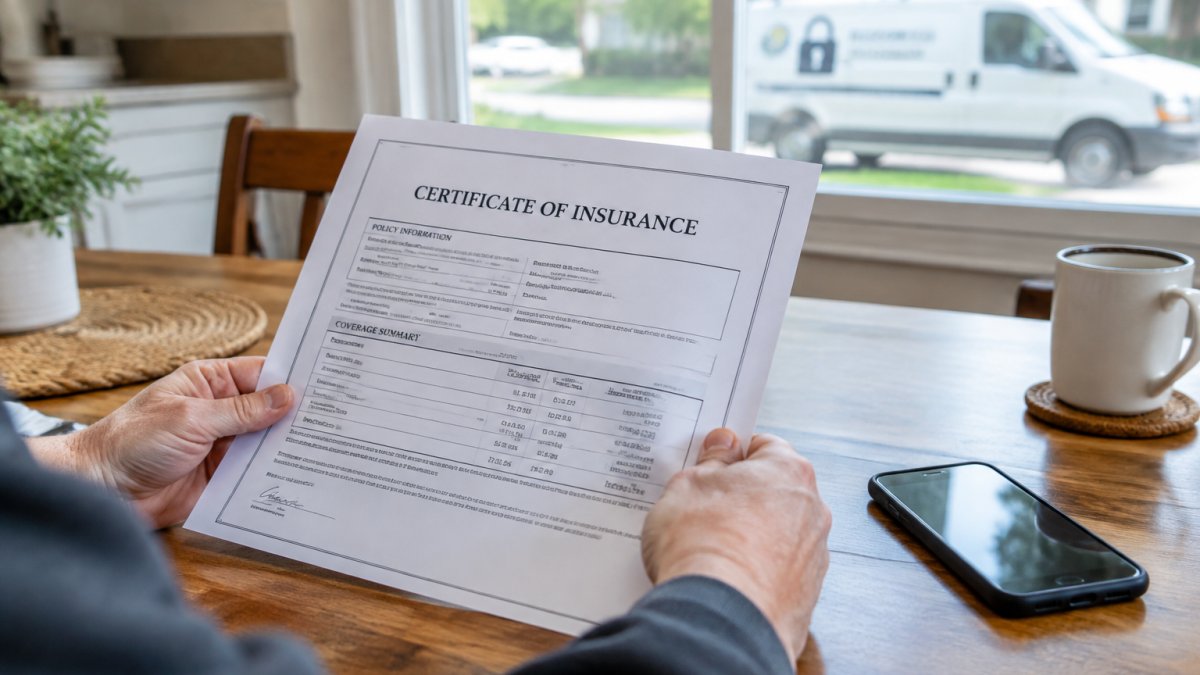
A certificate of insurance (often called a COI or ACORD 25 form) is the document that summarizes coverage. It names the insured, the insurer, the policy number, the policy limits, and the effective and expiration dates.
Reading a Certificate of Insurance
The certificate should show:
- Insured name: the legal business name, matching the name on your quote and the Iowa business registry
- Insurer name and NAIC number: the carrier and its identifier, so you can look it up and call it
- Policy number and policy type: general liability is the baseline; commercial auto matters if the technician drives to your address
- Policy limits: per-occurrence and aggregate limits, stated in dollars
If the insured name doesn't match the company on your quote, stop. That mismatch is exactly how uninsured operators hide behind someone else's paperwork, and it is the single most common problem with a forwarded certificate.
Watch out: a certificate with an expiration date that has already passed, or one that lists a policy period ending before your scheduled job, proves nothing about coverage on the day the technician arrives.
Verifying Coverage Directly With the Insurer
Call the insurer listed on the certificate and confirm the policy is active. This takes minutes and it's the step almost nobody does. Use the carrier's main claims or policy-services number, not a number printed on the locksmith's own paperwork, so you know you're talking to the insurer.
Ask these questions:
- Is this policy currently active, and what are the effective and expiration dates?
- Does the policy cover locksmith, lock installation, or property-access work?
- Does it cover work performed at the address where the job is happening?
- Is the insured name on the policy the same business that quoted me?
- What are the general liability limits per occurrence and in aggregate?
A certificate can be altered. A phone call to the insurer can't be faked.
What Each Credential Actually Proves
Insurance is one credential among several, and they are not interchangeable. Knowing what each one proves keeps you from accepting a substitute that doesn't cover the risk.
- A state locksmith license: proves the state screened the holder, where the state issues one. Iowa does not, so this box is empty here.
- A business registration: proves the entity exists and is active with the Iowa Secretary of State. It says nothing about skill or insurance.
- A certificate of insurance: proves a policy exists on paper. Only the insurer call proves it is active and covers the work.
- A certification or trade membership: proves the holder paid dues or passed a test with a private organization. It is not a government license and does not replace insurance.
Watch out: a locksmith who offers a "certification" in place of a certificate of insurance is answering a different question. Ask again for the COI and the insurer's phone number.
Questions to Ask Before Hiring a Locksmith
Ask for the business address, proof of insurance, and a written estimate before you agree to anything. A real professional answers these without hesitation.
Use this checklist before you book:
-
What is your business name and physical address?
-
Can you send a certificate of insurance?
-
What is your total price, in writing, before you start?
-
Are there any additional fees for after-hours or emergency calls?
-
What is your name, and will you be the one arriving?
That last question matters. Many "local" locksmiths are dispatch networks that send whoever is available. Ask who is actually coming, and confirm identity when they arrive.
For more on vetting questions, our guide on choosing a reliable locksmith walks through the full list.
Locksmith Estimate and Service Fees: What to Confirm Upfront
Get the total price in writing before work starts, including any after-hours, trip, or hardware fees. Pricing depends on the job, so ask for a written quote before work begins.
Confirm these upfront:
- Base service call fee
- After-hours or emergency surcharge
- Parts and hardware costs
- Whether the quote is a flat rate or an hourly rate
Watch out: if the price changes after the lock is already drilled, you're in a weak position. Ask for the number before the drill comes out. Our breakdown of hidden fee scams covers the patterns to recognize.
What to Do When Locksmith Licensing Is Not Required in Your Area
When no licensing registry exists, verification moves to insurance, business registration, and identity checks. You don't lose the ability to vet someone. You just shift where you look.
Do these instead:
- Confirm the business is registered with the state
- Request and verify a certificate of insurance directly with the insurer
- Ask for a written estimate before work begins
- Confirm the technician's name and identity on arrival
- Check consumer reviews and complaint history
This is the reality in much of Iowa. No state locksmith license means no database to search, so the insurance check becomes your main safeguard. Treat it that way.
Emergency Call Safeguards for Council Bluffs Homeowners
For a Council Bluffs emergency lockout, verify the dispatcher's business name, ask for a written price before dispatch, and confirm the technician's identity at the door. Emergency situations are when scams work best, because you're rushed and stressed.
Local safeguards that help:
- Save a verified locksmith's number before you need it
- Ask for the total price on the phone, then confirm it in writing
- Request the technician's name before they arrive
- Never pay in cash without a receipt
- Confirm the business address is real and local
Council Bluffs homeowners should also know that a legitimate mobile locksmith comes to you. If you're locked out at night, our residential locksmith service in Council Bluffs is built for exactly that call.
Book a Verified, Insured Locksmith for Your Next Job
Verification comes down to three checks: confirm the business, confirm the insurance, and confirm the price. Do those three things and you've eliminated most of the risk.
For business owners, the stakes are higher. Our commercial locksmith service in Council Bluffs is fully insured and ready for that work.
A locked door at midnight or a storefront that needs new hardware shouldn't come with guesswork about who's showing up.
Frequently Asked Questions
How can I verify that a locksmith is insured?
Ask the locksmith for a current certificate of insurance before any work begins. The certificate should list the business name, policy number, coverage dates, and liability limits. Then call the insurance company listed on the document to confirm the policy is active and covers locksmith work. A legitimate locksmith will provide this without hesitation. If they refuse or stall, treat it as a red flag and look for another provider.
Can I ask a locksmith for proof of insurance before they start work?
Yes, and you should. Request the certificate of insurance when you book the appointment, not after the technician arrives. Confirm the policy covers general liability. Compare the business name on the certificate to the name on their license and estimate. Any mismatch deserves a follow-up question. Reputable locksmiths expect this request and keep current documents ready to share.
What credentials should I check before hiring a locksmith?
Check for an active business registration and proof of insurance. Confirm the business name and address match what appears on the estimate. Look up customer reviews and confirm the phone number and website are consistent across listings. A locksmith who answers these questions clearly and quickly is usually a safer hire.
What should I ask a locksmith before they start work?
Ask for the total estimate and service fees upfront, including any trip charge, after-hours rate, or parts cost. Confirm the insurance coverage. Ask whether the technician is an employee or a subcontractor. Get the business address and a direct phone number. For lockouts, confirm the price before they drill or pry anything. Written or texted estimates protect you if the final bill differs from the quote.