 listicle
7 Tips for Choosing a Reliable Locksmith
Table of Contents
- 1. Verify Professional Credentials and Licensing
- 2. Check Insurance and Bonding Status
- 3. Review Customer Feedback and Ratings
- 4. Ask the Right Questions Before They Arrive
- 5. Understand Emergency Locksmith Services Cost Upfront
- 6. Identify and Avoid Locksmith Scams
- 7. Choose a Local, Reliable Locksmith Over National Call Centers
- Frequently Asked Questions
Last Updated: September 1, 2026
7 Tips for Choosing a Reliable Locksmith
When you're locked out of your home at midnight or your business door won't open before an important client meeting, the last thing you want is to discover you've hired an unreliable locksmith. Finding a reliable locksmith matters more than most people realize, the wrong choice can cost you time, money, and peace of mind. At Blackshirt Lock & Key, we've worked with homeowners, property managers, and business owners in our service area, and we've seen firsthand how much difference it makes when you know what to look for before you call.
The stakes are real. A scam artist might charge triple the fair price, damage your locks during installation, or disappear before finishing the job. A reliable locksmith, by contrast, shows up quickly, does quality work, and charges honest prices with no surprises. This guide covers seven practical tips for choosing a reliable locksmith, the same criteria we'd recommend to a friend or family member.
1. Verify Professional Credentials and Licensing
The first step in choosing a reliable locksmith is confirming they're actually licensed to do the work. Locksmith licensing requirements vary by state, and some states don't require licensing at all, which creates room for unqualified operators (ncsl.org). In states that do require licensing, a legitimate locksmith should be able to show you their license number and proof of credentials without hesitation.
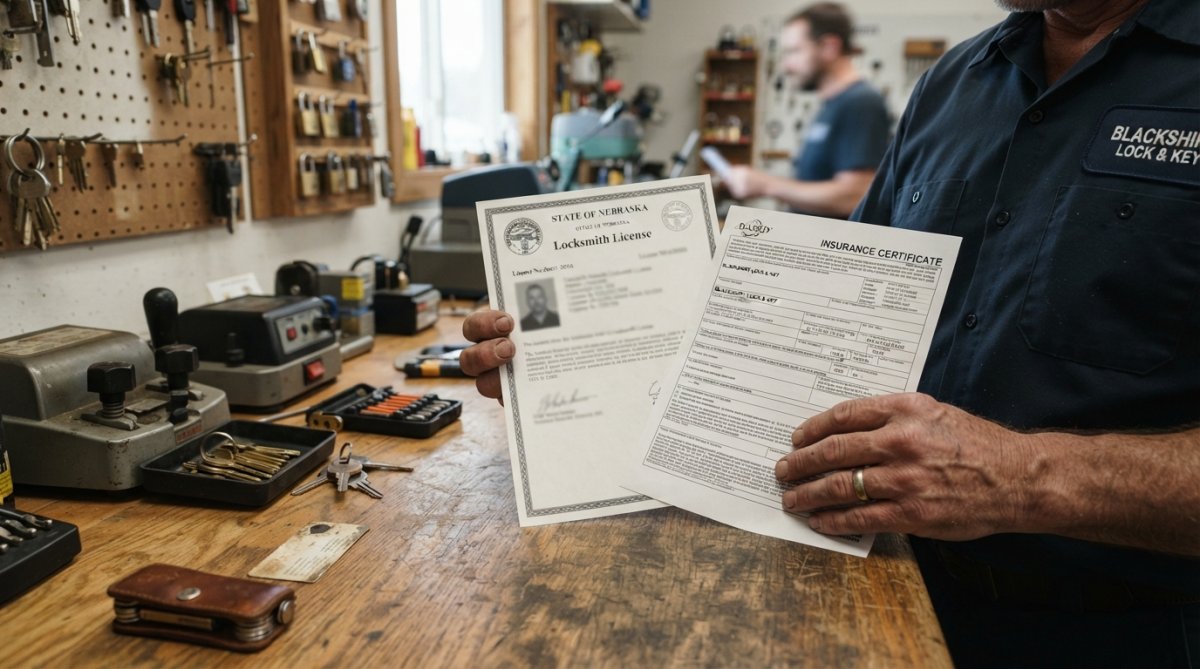
Ask the locksmith directly: "What state license do you hold, and what's your license number?" A reliable locksmith will provide this information immediately. You can then verify the license through your state's licensing board or contractor registry. If they refuse to provide a license number or claim they don't need one, that's a red flag. Many scam operations prey on customers who don't ask this basic question.
Beyond licensing, check whether the locksmith has any relevant certifications. Organizations like the Associated Locksmiths of America (ALOA) offer professional certifications that demonstrate a locksmith has passed rigorous training and background checks (aloa.org). While not every legitimate locksmith holds ALOA certification, it's a strong signal of professionalism and commitment to the trade.
Professional credentials matter because they indicate someone has invested in their training and agreed to uphold industry standards. A reliable locksmith takes pride in their qualifications because they know it builds trust with customers.
2. Check Insurance and Bonding Status
Insurance and bonding are non-negotiable when hiring a reliable locksmith. Here's why: if something goes wrong, a locksmith accidentally damages your door frame, loses your keys, or causes injury on your property, you need assurance that you're protected. A bonded and insured locksmith has coverage that protects you if problems occur.
Ask the locksmith: "Can you provide proof of general liability insurance and bonding?" A reliable locksmith will have this documentation readily available. General liability insurance covers damage to your property, while bonding protects you if the locksmith commits theft or fraud (iii.org). Some locksmiths also carry workers' compensation insurance, which protects their employees and further demonstrates legitimacy.
Request to see the insurance certificate before they start work. Check that the policy is current and that the coverage amounts are adequate for residential or commercial work, depending on your needs. If a locksmith can't provide proof of insurance, find someone else, the risk isn't worth the savings.
Being fully insured is one of the hallmarks of a reliable locksmith. It shows they're established, professional, and willing to stand behind their work. At Blackshirt Lock & Key, we carry full insurance coverage on all our mobile services because we know our customers need that protection and peace of mind.
3. Review Customer Feedback and Ratings
Word-of-mouth and online reviews give you real insight into whether a locksmith is reliable. Before calling, search for the locksmith's name on Google, Yelp, the Better Business Bureau (BBB), and local service review sites. Look for patterns in what customers say, not just the star rating.
Pay attention to reviews that mention specific details: response time, professionalism, whether the locksmith explained the work clearly, and whether the final bill matched the estimate. A reliable locksmith will have mostly positive reviews that highlight quick response, honest pricing, and quality work. If you see multiple complaints about overcharging, long wait times, or poor communication, move on.
Red flags in reviews include customers saying they were surprised by the final bill, the locksmith was rude or dismissive, or the work was sloppy. If several reviews mention the same problem, that's a pattern worth avoiding. Conversely, if most reviews mention that the locksmith showed up quickly and charged a fair price, that's a strong signal of reliability.
Check the BBB rating for any unresolved complaints. The BBB doesn't rate individual locksmiths in all areas, but if you find a profile, look at how the business responds to complaints. A reliable locksmith takes feedback seriously and works to resolve issues.
4. Ask the Right Questions Before They Arrive
Before a locksmith comes to your home or business, prepare a list of questions. This conversation will tell you a lot about whether they're reliable and professional. Here are the questions that matter most:

What's your typical response time for emergency calls? A reliable locksmith should give you a realistic estimate. If they promise 10 minutes and you're 20 minutes away, that's a red flag. Blackshirt Lock & Key, for example, prioritizes fast response times for emergency lockouts because we understand the urgency.
Will you provide a written estimate before starting work? This is critical. A reliable locksmith will either give you a firm quote over the phone or provide a written estimate on-site before touching anything. They should explain what the charge covers and whether there are any additional fees for specific situations.
Do you charge a service call fee? Some locksmiths charge just to come out and assess the problem. Others only charge if you hire them. Understand this upfront so there are no surprises.
Are you available 24/7, or do you have specific hours? If you need emergency locksmith services, knowing availability matters. Some locksmiths work standard business hours only, while others offer round-the-clock service.
How long have you been in business? A reliable locksmith with years of experience in the local area is generally safer than someone brand new. Experience matters because it means they've handled diverse situations and built a reputation.
Will you provide references? A confident, reliable locksmith should be willing to provide a few customer references you can contact.
A reliable locksmith answers these questions clearly and doesn't get defensive. If they seem evasive or impatient with your questions, that's a sign to look elsewhere.
5. Understand Emergency Locksmith Services Cost Upfront
One of the biggest complaints about locksmiths is surprise charges. A reliable locksmith discusses pricing transparently before starting work. Understand the different cost components so you're not caught off guard.
Emergency locksmith services typically include a service call fee, labor charges, and material costs for any parts used (like new locks or keys). The service call fee covers the locksmith's travel time and availability. Labor charges cover the time spent on the actual work. Material costs depend on what needs to be done, rekeying is different from installing a new lock, which is different from cutting keys.
Ask the locksmith to break down these costs before they start. A reliable locksmith will explain what you're paying for and why. For example: "The service call fee is $X, labor to rekey your lock is $Y, and the new keys will be $Z, for a total of $[amount]." This transparency builds trust.
Also ask whether the quoted price is a flat rate or an estimate. A flat rate means the final bill will match the quote. An estimate means the final bill might be slightly higher if the job takes longer or requires unexpected materials. Either way, a reliable locksmith will tell you upfront and won't significantly exceed the estimate without your approval.
Avoid locksmiths who quote prices over the phone without knowing what they're working with. Legitimate work requires assessment. However, once they assess the situation, a reliable locksmith should give you a firm quote before proceeding.
6. Identify and Avoid Locksmith Scams
Locksmith scams are common enough that you need to know the warning signs. Scammers use several tactics to overcharge or defraud customers. Knowing these patterns helps you avoid them.
The bait-and-switch: A scammer quotes a very low price over the phone to get you to call them, then dramatically increases the price once they arrive, claiming the job is more complex than expected. They pressure you to pay the inflated amount. A reliable locksmith gives accurate quotes based on understanding what needs to be done.
The unnecessary work: Some scammers recommend locks, rekeying, or other services you don't actually need. They'll say your locks are "not secure enough" or "outdated" to justify expensive upgrades. A reliable locksmith assesses your actual needs and recommends solutions that make sense for your situation.
The unlicensed operator: Scammers often work without licenses or insurance. They might use a generic name like "ABC Locksmith" or "24-Hour Locksmiths" to avoid identification. When you ask for credentials, they refuse or provide fake documentation. A reliable locksmith proudly displays their real license and insurance.
The cash-only demand: Some scammers insist on cash payment only, which leaves you with no paper trail and no recourse if something goes wrong. A reliable locksmith accepts multiple payment methods and provides a written receipt.
The no-show: A scammer takes your call, quotes a price, and then never arrives. You're left locked out with no solution. A reliable locksmith confirms the appointment, communicates if there are delays, and shows up on time.
To avoid these scams, verify credentials before calling, get everything in writing, ask for multiple payment options, and trust your gut. If something feels off, it probably is.
7. Choose a Local, Reliable Locksmith Over National Call Centers
When you search for "locksmith near me," you might see national call center services that dispatch local locksmiths. These services can work, but they add a middleman that often means higher costs and slower response times. A local, reliable locksmith is usually the better choice.
Here's why: when you call a national call center, they take your information, dispatch a local locksmith, and take a commission on the job. That commission gets passed to you as a higher bill. You also lose direct communication, you're talking to a call center representative instead of the locksmith who will actually do the work. If something goes wrong, you're dealing with a customer service line instead of the person responsible.
A local, reliable locksmith operates independently or as a small local business. You call them directly, speak with the owner or a trusted team member, and build a relationship. They have a reputation to protect in your community, so they're motivated to do good work and treat you fairly. If you need locksmith services again, you already know who to call.
Local locksmiths also typically have faster response times because they're already in your area. A reliable locksmith who knows your neighborhood can reach you quicker than a call center that has to dispatch someone from across town.
When choosing between a national call center and a local locksmith, ask yourself: do you want to pay more for an extra layer of bureaucracy, or would you rather deal directly with the person doing the work? For most people, the answer is clear.
Choosing a reliable locksmith protects your home, your business, and your wallet. Verify credentials, confirm insurance and bonding, check customer reviews, ask the right questions upfront, understand pricing before work begins, watch for scams, and choose a local locksmith you can trust. These seven steps take time but save you from costly mistakes and poor service.
At Blackshirt Lock & Key, we've built our reputation on reliability, fully insured service that comes directly to you with straightforward pricing and no hidden fees. When you need a locksmith you can count on, call us for fast, professional solutions for your home, vehicle, or business. Call now to get started.
Frequently Asked Questions
How do I verify a locksmith's credentials before hiring them?
Ask for their license number and verify it with your state's licensing board. Request proof of insurance and bonding. A reliable locksmith will provide these documents without hesitation. Never hire someone who refuses to show credentials or gets defensive when asked.
What questions should I ask a locksmith before they arrive?
Ask about their service call fee, estimated total cost, and whether they charge extra for after-hours work. Confirm their estimated arrival time and ask if they're fully insured for your type of job (residential, commercial, or automotive). Request that they provide a written estimate before starting work. These questions help you avoid surprises and ensure you're working with a professional who operates transparently.
How much do emergency locksmith services typically cost?
Emergency locksmith services cost varies based on the type of lock, time of day, and complexity of the job. After-hours calls usually include a higher service fee than daytime appointments. Rather than guessing at pricing, ask for an on-site estimate before work begins. Reputable locksmiths provide written quotes upfront so you know exactly what you'll pay before they touch your locks.
What red flags should I watch for to avoid locksmith scams?
Avoid locksmiths who quote prices over the phone without seeing the lock, demand cash-only payment, or refuse to provide written invoices. Be wary of extremely low prices that seem unrealistic, as this is a common bait-and-switch tactic. Always ask for identification when they arrive, verify their vehicle has company branding, and never let them pressure you into unnecessary services. Legitimate locksmiths are transparent about fees and happy to answer all your questions.